
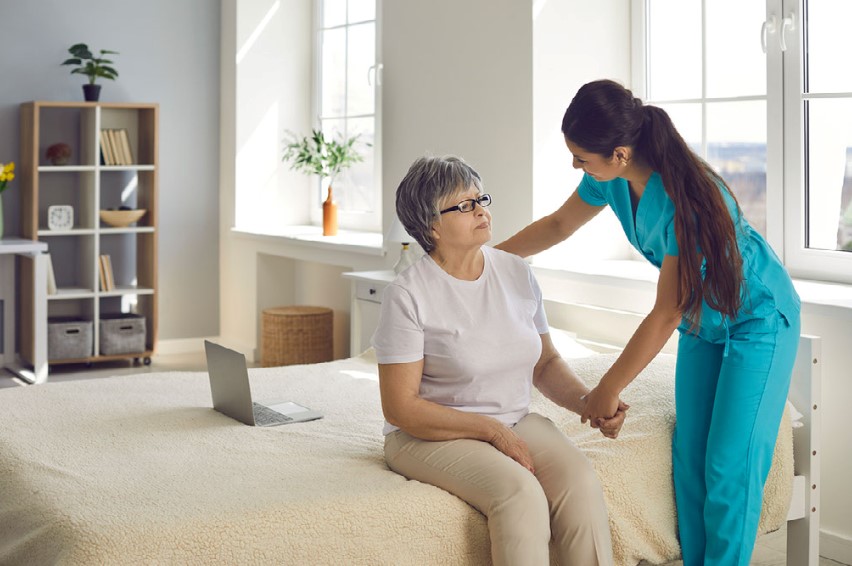
Your dad suffers from extreme Arthritis and it’s gotten worse as he’s gotten older. You’ve noticed how difficult it is for him to get in and out of his chair and you’re pretty sure he’s sleeping in that chair. And then it happened… what you’ve secretly been afraid of…he fell. Today we’re talking about transfers in Assisted Living.
Last week we talked about weight in Assisted Living and how that affects transferring but it’s not just weight. It’s arthritis, a stroke, Parkinson’s Disease, surgery or a fall… and no matter how much your mom or dad weighs, transfer assistance can be more expensive and may not be available at every Assisted Living.
So today we’re going to talk about the different types of transferring, how it affects caregivers and why you should start your call with this topic when looking for Assisted Living.
We recently had a client who not only suffered from severe arthritis, but also had two broken hips, knee replacements, and was just in so much pain. She had been living on her own, with some in-home care until she fell. This fall resulted in a hospital stay, and then a skilled nursing stay, and in these two environments, the physical therapy was just too difficult for her. She never regained the strength that allowed her to get in and out of her chair at home and use the restroom on her own despite the pain. It really is true. If you don’t use it, you lose it. She now required a two person assist with a Hoyer lift, which is a mechanical lift. We talked about that last episode and I’ll put another link in this blog’s note.
At this point, she could not bear her own weight. She was unable to stand. She was only about 100 pounds and even though yes…a strong male caregiver could have lifted her. It was just too painful.
But she wanted to get out of bed. She wanted to use the restroom. So they found an Assisted Living that said they could do the transfers, but when the family moved their mom in they discovered that the Assisted Living only had one caregiver. That may not have been a problem for another resident and their transfer needs but for our client… having one person lift her caused so much pain. The caregiver did their best, but it just wasn’t a viable option. She was using the restroom in her bed and not being transferred to the restroom which was a huge dignity issue for her when I met with her. She was just crying and crying not only at the loss of mobility and the loss of her home but the pain and thinking that she would be able to be transferred and it just not happening. Let me say again… this Assisted Living said that yes they could do the transfers. This is why it’s so important to ask about staffing and training.
Before I tell you how this story ends, let’s talk about the different types of mechanical transferring options:
Gait belt
Hoyer
Overhead lift
Slide board
Sit to Stand
Let’s start with the gait belt. This is exactly what it sounds like. It is a belt that you wrap around the middle of your loved one and this allows you to have something safe to grab onto to assist them in a transfer. So this is potentially for when your mom or dad are having trouble getting out of their chair but they can still bear weight. This allows you to safely help them out of their chair without grabbing an arm which can cause injury.
This is also a really great way to help your loved one walk with you if they can walk independently but they’re a little unsteady. You can have that hand on that gait belt, just in case they start to fall.
Everything that we were talking about today is equipment that you could have in the home as well. While there are YouTube videos on how to use all of the equipment, I would definitely recommend enlisting the assistance of a physical therapist or an occupational therapist, and in certain situations Medicare may cover physical therapy or occupational therapy sessions to get you started.
The Hoyer Lift is an actual machine and it’s something that you definitely need enough space in the bedroom or your home wherever you’re using this in order to use it. It’s an actual mechanical lift that you position a sling underneath your loved ones and then you use this mechanical machine to actually lift your loved one and then you have the ability to turn the machine so that you can then safely position them and let them down over their wheelchair onto a toileting chair, whatever the situation is. Now there are situations where we see one person operating this machine and it’s sort of what it’s designed for, but it really depends on your situation and so very often for safety reasons you’ll see that it is a requirement for two caregivers to use this machine and this could be in situations where it’s a bariatric resident or your loved one is in so much pain that it requires two people to make sure everything repositioned when necessary to make it the least painful.
There is also a mechanical lift that is an overhead lift that actually just like it sounds it’s positioned with rails in the ceiling and we see these most often in hospitals and skilled nursing settings. It is something that’s available for the home, but it’s extremely pricey.
The slide board is also another transferring option and the slide board is again just like it sounds. It is a board that you position under your loved one from the wheelchair to the bed. It requires taking an arm off the wheelchair so that you can have a smooth transfer board transfer into the shower and so it has a lot of different uses. It’s usually used with a gait belt as well because you’re helping your loved one slide over on that slide board.
Then there are other options such as grab bars and something called a Sit to Stand, which is a large suspension rod that goes from the ceiling to the floor and it has adjustable handles so you can position it in the middle of the room wherever it’s needed. If your loved one has upper body strength and they’re able to help with the transfer then it can also help them feel more independent.
Let’s get back to my story. Our client ended up in a situation where the Assisted Living was not able to meet her transferring needs so she ended up moving to a situation where the Assisted Living had the staffing they had to caregivers that were able to help with a Hoyer Lift. They were able to get her to the restroom and help her feel a little bit more independent.
No matter what your situation, having mobility and the ability to get out of your chair when you want to go and use the restroom as opposed to using a Depends is a huge dignity and independence issue most Assisted Living Communities and Adult Family Homes should aim to keep your loved one as independent as possible for as long as possible.
If you’d like to check out our blog post in podcast form, be sure to take a listen HERE!
Click HERE for our Doable Download, which provides the resources referenced in the post
Subscribe to our YouTube page!